Audiometry (hearing test)
 +381 64 4184 444
If you notice reduced hearing, ringing in your ears, or a feeling of fullness, it’s time to consider a hearing test. One of the most reliable ways to check your hearing is audiometry. A simple ENT exam with audiometry helps detect various issues. At Dr Prlja Medical in Belgrade, this test is performed precisely, painlessly, and under controlled conditions. The exam is quick, and results are available immediately. If you struggle to understand speech in noisy places or often turn up the volume on devices, don’t wait. Timely testing can improve your daily quality of life. Schedule your exam today and find out if your hearing is in good condition.

What is audiometry and how can it help you?
Audiometry is a test used to examine your sense of hearing. It’s a non-invasive diagnostic method used to assess symptoms that may point to hearing loss. The test measures how quietly you can hear sounds at different frequencies, helping the ENT team detect possible hearing damage—whether temporary or permanent. It’s important to monitor hearing early, as early diagnosis increases the chances of effective treatment.
There are two main types of audiometry:
- Pure tone audiometry: A hearing test that measures how well you hear tones at different frequencies. The test continues until your hearing threshold is found for both ears.
- Speech audiometry: A test focused on your ability to understand words, often with background noise, to see how clearly you hear speech.
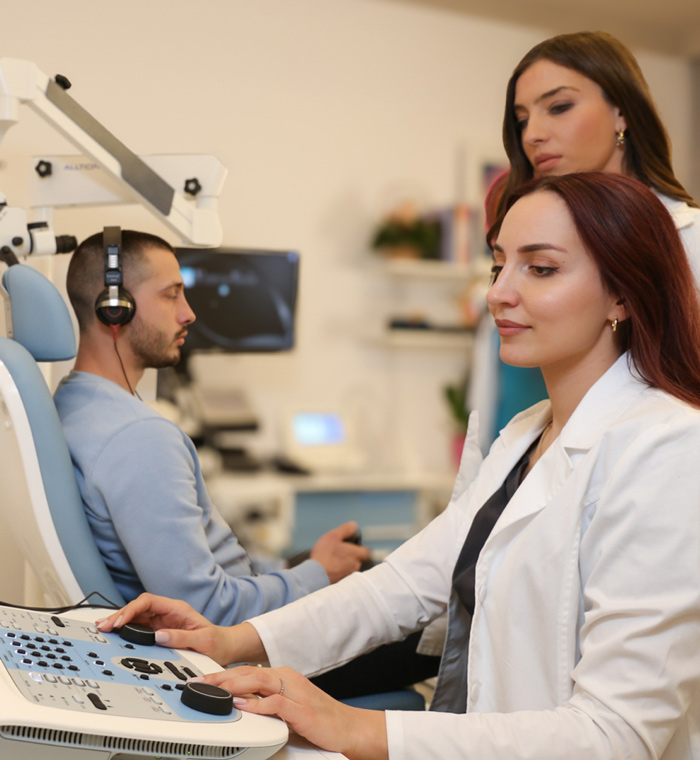
The audiometric exam is performed by our experienced ENT doctors. This hearing test is conducted in a soundproof booth. The entire process takes about 15–30 minutes. The exam is painless – the test is completely comfortable and non-invasive.
When is the right time to schedule an audiometry test?
Do you have ringing in your ears, feel like your hearing is “blocked,” or struggle to follow conversations? These are often the first signs that it’s time for an ENT exam with audiometry. Tinnitus, or ringing in the ears, affects nearly 20% of the population. It’s even more common among older adults and those exposed to noise—another reason to check your hearing in time. Common symptoms include:
- Ringing (whistling, rustling, or pulsing) often signal hearing issues
- Difficulty understanding speech, especially in noisy places, may point to early hearing loss
- A “blocked” feeling in the ears can result from Eustachian tube problems and may require further evaluation
Audiometrija je posebno preporučena za:
- Children with delayed speech development, since mild hearing loss is one of the most common ENT issues in children and can greatly affect learning and communication.
- Older adults and people working in noisy environments, such as construction sites or factories, where preventive checkups can help protect hearing.
- Medical checkups for employment, driving, or firearm permits, as audiometry is often a standard part of these health assessments.
If you notice any of the listed symptoms, we recommend scheduling an audiometry exam as soon as possible. Our team is here to guide you through every step of the ENT ear exam process, from diagnosis to proper treatment. Your health and peace of mind are our priority.
What can you expect during the exam?
The exam begins with a conversation about your symptoms and medical history. The doctor or audiometrist may ask about hearing aid use, ringing in the ears, and your daily hearing environment. After that, you’ll enter a soundproof booth that ensures accurate results. Inside the booth, you’ll wear headphones and respond by pressing a button or moving your hand each time you hear tones at different frequencies—this is called pure tone audiometry. Then comes speech audiometry, where you repeat the words you hear, with or without background noise, to assess how clearly you understand speech. You don’t need any special preparation—just be rested and focused. Bring with you:
- previous medical records
- your hearing aid, if you use one, or adjust it in advance
- a list of vitamins, medications, or other treatments you’re taking
What do audiometry results mean?
Audiometry results are shown in the form of an audiogram—a chart with frequency (Hz) on the horizontal axis and sound intensity (dB) on the vertical axis. Each point on the graph represents the softest level at which you can hear a certain tone. The lower the point on the graph, the greater the hearing loss.
Normal hearing values for adults range from –10 to +25 dB. For children, hearing is considered normal up to +15 dB. If your hearing level is above +25 dB, it may indicate some degree of hearing loss:
- Left or right ear: a difference may suggest asymmetric hearing loss
- Hearing loss in both ears: could point to sensorineural or conductive hearing loss
You receive the results immediately after the exam. Our ENT doctor will carefully interpret the audiogram and provide guidance on the next steps.
What conditions can audiometry detect?
Audiometric testing is a reliable method for identifying hearing problems in both children and adults. Based on the results, an ENT doctor can determine the exact type of hearing loss and recommend the right treatment. At Dr Prlja Medical, this test is used for early detection and monitoring of various hearing-related conditions.
Conditions that can be diagnosed with an audiometry test include:
- Inner ear or auditory nerve damage that affects your ability to hear and understand clearly
- Disorders in the middle or outer ear that block proper sound conduction
- Combined hearing issues affecting multiple parts of the hearing system
- Structural changes in the middle ear that reduce movement of the auditory bones
- Age-related hearing loss that affects both ears
- Ringing in the ears (tinnitus), which may signal deeper hearing issues
- Uneven hearing between the left and right ear that needs further evaluation
- Hearing loss due to loud noise exposure, especially in the workplace
- Hearing damage caused by certain medications, often after severe ear infections or strong treatments
Vrste gubitka sluha koje audiometrija može otkriti
Audiometry allows for precise identification of the three main types of hearing loss, which is essential for planning further treatment:
- Sensorineural hearing loss occurs when the inner ear or auditory nerve is damaged. It is usually permanent and is most common in older adults or people exposed to loud noise over time.
- Conductive hearing loss happens when sound cannot travel properly through the outer or middle ear. It is often caused by infections, earwax buildup, or issues with the middle ear bones and is usually temporary.
- Mixed hearing loss is a combination of sensorineural and conductive hearing loss and requires a detailed evaluation. Treatment often involves both medical therapy and hearing aids.
Audiometry helps not only with detecting issues but also with monitoring hearing over time. Based on the results, the ENT specialist may recommend further tests, hearing aids, or other treatment options.
Why choose Dr Prlja Medical in Belgrade
At Dr Prlja Medical, we are committed to top-quality hearing care, backed by years of experience from our ENT specialists. We use accurate diagnostics through audiometry tests and offer a personalized, attentive approach to every patient. We take special care with children, older adults, and clients who may feel anxious—exams are gentle, and communication is always clear. Appointments are scheduled quickly, and results are available right after the exam without waiting.
If the test shows a problem, the next steps include:
- a consultation with an ENT specialist who explains the results in detail
- additional testing if needed
- a therapy plan, hearing aid, or in more serious cases, a cochlear implant
Follow-up exams can be done directly at our clinic, making it easier to track progress and adjust treatment over time.
Don’t ignore changes in your hearing
Hearing changes often happen gradually, which is why many people overlook them. However, early detection is essential—the sooner you act, the better your chances of preventing permanent damage. Audiometry is a simple and accurate test that can detect even mild hearing loss, often before it affects your daily life. If you notice ringing in your ears, have trouble following conversations, or sounds seem muffled, don’t wait. One exam can make a big difference. At our Dr Prlja Medical in Belgrade, we perform audiometry with expert support and a modern, patient-centered approach. Schedule your exam today and find out if your hearing is working as it should. Your hearing deserves attention—and you deserve a clear, reliable view of your health.
Achieve flawless results with personalized treatments that highlight your natural beauty.
Frequently asked questions and answers
Do I need a referral for audiometry at a private clinic?
No, you don’t need a referral for an audiometry exam at Dr Prlja Medical. You can book your appointment directly by phone or through the online form.
How often should I have an audiometry test if I have no symptoms?
A hearing check is recommended every two years. If you work in a noisy environment or have a family history of hearing problems, testing once a year is advised.
Can children under three years old undergo audiometry?
Yes, audiometry is completely safe during pregnancy. It’s non-invasive, involves no radiation or medications, and is done under controlled conditions.
Can audiometry be done during pregnancy?
Da, audiometrija je potpuno bezbedna za trudnice jer je neinvazivna, bez zračenja i lekova, i izvodi se u kontrolisanim uslovima.
Can audiometry be performed if I have a cold or blocked ears?
It’s best to wait until acute symptoms go away. A cold or blocked ears can temporarily affect the test results.
Are audiometry results stored for future comparison?
Yes, all results are stored in the clinic’s records. This allows for ongoing monitoring and timely intervention if hearing changes over time.
Experiences of those who chose us
My experience with Sara was actually my first treatment ever. I had always been skeptical until I met her through a mutual friend. All it took was seeing her flawless skin to completely trust her. Not only does she maintain a natural look, which I really appreciate, with minimal corrections, but she’s also a wonderful friend and, when needed, a great therapist. I always leave her office feeling satisfied and smiling. P.S. She’s the only one who managed to solve my under-eye bags!

-Ksenija Knezevic
Singer
I met Sara a few years ago, and after the first treatment, I was certain – this woman knows what she's doing! I trust her completely, and I love her approach, honesty, and directness. There’s no exaggeration or unnatural looks – just a refreshed, rested, and natural appearance. We always have so much fun, laughing, while also enhancing our beauty. After seeing Sara, I look like I’ve just returned from the best vacation!
-Matea Milosavljevic
Actress
I have known Sara Prlja for more than 15 years, and I can say that everything she envisioned, she has achieved. She has always worked on herself, invested in her knowledge and growth. Her clinic is the perfect place where you will feel comfortable and relaxed, and the service is top-notch. I highly recommend her and her work!

-Aleksandar Dramicanin
Hair & Makeup Artist
Love, trust, and respect are the foundation of every strong and lasting relationship, whether personal or professional. From a medical perspective, we know how essential support is in any healing process, but for me, the relationship between a doctor and a patient is one where trust is especially important. I have complete trust in Sara and always feel confident that everything will be okay. That trust creates a sense of safety and allows real progress, while care and connection give us the space to grow together. I have never viewed my relationship with Sara as just professional, because every time I visit the clinic, it feels more like coming to people I trust and feel close to rather than simply working with a provider. That is the X factor that makes this experience truly valuable to me.

-Nataša Kovačević Njezvanova
Influencer
My experience with Sara has been exceptional in every way. Above all, she is a genuinely kind person and an outstanding professional. Together with her wonderful team, she creates an atmosphere free of fear, where trust comes naturally. I am delighted with the results and feel beautiful, confident, and happy. I wholeheartedly recommend her.

-Mahrina
Singer
I don’t easily trust anyone with my skin care, but the moment I stepped into Dr Prlja Medical, I felt safe and confident in my choice. I wouldn’t replace Sara for anyone else. She combines expertise, warmth, and a genuine love for her profession. Every treatment leaves me feeling refreshed and renewed, both physically and emotionally. Trust me when I say that you are in the right place.

-Anja Ćurčić
Actress