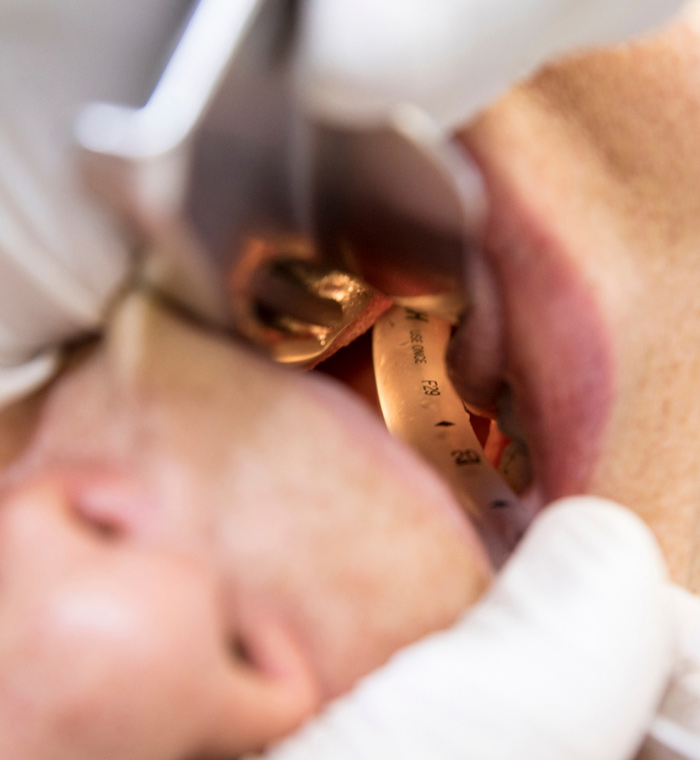
Endoscopic examination of the pharynx and larynx
 +381 64 4184 444
Endoscopy of the pharynx and larynx is a reliable method for detecting the causes of sore throat, hoarseness, or swallowing difficulties. This examination allows the doctor to clearly assess the condition of the pharynx and larynx and identify changes that often remain unnoticed during a standard check-up. At our clinic, Dr Prlja Medical in Belgrade, you can undergo an endoscopic throat examination with the support of an experienced team specializing in accurate diagnostics and treatment of voice and throat conditions. The procedure is quick, safe, and provides immediate results, which means you will receive guidance for further treatment right away. If you already have concerning symptoms or simply want to check your health, do not postpone the examination. Book an appointment with us and receive reliable diagnostics and expert care.

Advantages of precise throat endoscopy in ENT diagnostics
Endoscopic throat examination is considered the gold standard in detecting and evaluating changes that cannot be seen during a standard ENT check-up. While a traditional examination with a lamp and mirror provides only a limited view of the pharynx surface, endoscopic examination allows a detailed and magnified look at all structures — from the pharynx to the vocal cords and larynx.
The advantage of this method is that the doctor sees the actual condition of the mucosa in color and high resolution. This helps distinguish benign changes (such as inflammation or irritation) from more serious lesions requiring further diagnostics. Even the smallest irregularities in vocal cord movement are observed during the exam. This visual assessment is crucial for assessing voice or breathing disorders.
Unlike other methods, endoscopy in our ENT clinic in Belgrade also allows recording of findings. You immediately receive a visual overview of the problem. Afterwards, the doctor can compare results during follow-up visits and monitor therapy progress.
When is an endoscopic throat examination needed?
An endoscopic throat examination is recommended when symptoms do not go away on their own or are particularly intense.
- The most common reason patients seek this exam is hoarseness lasting longer than two to three weeks. Such a condition may indicate inflammatory changes of the vocal cords, but also more serious disorders such as nodules or polyps.
- Another important sign is pain when speaking or swallowing. A burning sensation, pressure, or pain in the pharynx may result from infection, reflux, or mechanical irritation, but if persistent or recurring, endoscopy is the best way to assess the condition.
- Chronic cough lasting for weeks without a clear cause is often due to reflux disease or hidden changes on the vocal cords and larynx. Endoscopy then allows the doctor to detect even the smallest abnormalities that a standard exam cannot reveal.
- Changes in voice tone or strength are also an important signal. If the voice becomes rough, weak, or unstable, endoscopy helps to accurately evaluate vocal cord mobility and detect possible lesions.
- The presence of mucus or traces of blood in the throat always requires thorough diagnostics. These symptoms may stem from inflammation, but also from more serious conditions, making timely examination essential for early and accurate evaluation.
What does an endoscopic throat examination look like and which conditions can it diagnose?
An endoscopic throat examination is designed to provide the patient with a sense of safety and comfort. In most cases, no special preparation is required — fasting is unnecessary unless the doctor advises otherwise. If the patient is taking blood-thinning medication or other specific therapies, the doctor will give precise instructions regarding possible temporary discontinuation.

A thin flexible endoscope is used for the procedure, allowing a detailed view of the throat without pain. Before inserting the endoscope, a local anesthetic spray is applied to reduce discomfort. During the examination, the patient may feel slight pressure or the urge to cough. However, the procedure is generally quick and well tolerated. The exam usually lasts only a few minutes and can diagnose a wide range of ENT conditions.
Inflammatory changes – pharyngitis and laryngitis
During an endoscopic throat examination, inflammatory changes such as pharyngitis and laryngitis are often detected. These conditions can be acute or chronic and require different therapeutic approaches. The exam helps distinguish simple irritation from more serious inflammatory processes.
- In pharyngitis (inflammation of the pharynx), endoscopy shows redness and swelling of the pharyngeal mucosa, and sometimes whitish deposits or secretions.
- In laryngitis (inflammation of the vocal cords), endoscopy reveals thickened and swollen laryngeal mucosa, along with redness of the vocal cords and reduced closure during phonation (speaking).
These findings clearly differentiate mild irritation from a more serious infection that requires treatment.
Reflux disease and its effects on the vocal cords
In patients with reflux disease, changes on the mucosa of the vocal cords and larynx can often be observed. Stomach acid that flows back into the esophagus and throat damages the tissue, which is clearly visible through endoscopy as redness and swelling in the posterior part of the larynx and vocal cords.
In addition, thickening (hyperplasia) of the mucosa and traces of retained secretions are often seen. These changes are specific to chronic irritation caused by stomach acid and help in adjusting the treatment plan and setting up therapy for reflux in the laryngopharyngeal region.
Polyps, nodules, and early-stage tumors
The examination is also valuable for detecting polyps, nodules, and tumors in their early stages. Early identification of these changes enables timely treatment and significantly reduces the risk of complications. Vocal cord polyps and nodules appear as small growths or thickenings on the edges of the vocal cords, usually symmetrical in nodules and unilateral in polyps. Endoscopy provides a clear visualization of the size, color, and position of the lesion.
Early-stage tumors often appear as a small irregularity, color change, or rough surface on the vocal cord or laryngeal mucosa. Early detection allows for biopsy and quick further treatment.
Vocal cord mobility disorders
Endoscopy is also useful in diagnosing vocal cord mobility disorders. Such conditions can affect both voice quality and breathing, making accurate assessment of movement crucial when deciding on vocal cord surgery.
In cases of vocal cord paralysis or paresis, endoscopy shows reduced or absent movement of one or both vocal cords during speaking and breathing. The doctor can clearly see asymmetry and an irregular gap between the cords, which explains symptoms such as hoarseness or breathing difficulties. The recording may also reveal an abnormal vibration pattern of the vocal cords.
Dysphagia – swallowing difficulties
In patients with dysphagia, endoscopy can reveal anatomical obstructions (e.g., enlarged structures, polyps), as well as whether food or liquid remains in the pharynx. If necessary, microscopic removal of a foreign body may be suggested.
When the additional FEES test (Fiberoptic Endoscopic Evaluation of Swallowing) is used, the doctor records the swallowing process, observing pharyngeal and vocal cord movements, as well as any “wrong path” of food into the airways (aspiration). This provides a precise insight into the causes of swallowing difficulties and supports the diagnosis of dysphagia.

Why choose Dr Prlja Medical in Belgrade?
At Dr Prlja Medical, every patient receives the attention they deserve. Our team consists of doctors with years of experience in diagnosing and treating throat and vocal cord conditions.
- We place special emphasis on a personalized approach – since every person has different symptoms and needs, the diagnostic and treatment plan is tailored individually.
- The examination does not end when the patient leaves the office. We provide a written report with detailed explanations and recommendations, making follow-up easier. When necessary, the doctor gives a referral for additional tests or suggests therapy immediately after the exam.
- Follow-up throat examinations are an essential part of our practice. They allow us to monitor progress and respond promptly if new symptoms appear. This way, we provide long-term support for maintaining health, and patients can rely on our team even after the first visit.
- Our goal is to make every procedure as comfortable as possible, which is why each visitor receives a gentle and attentive approach. For those seeking expertise, care, and continuous support in treatment, Dr Prlja Medical in Belgrade is the right choice.
Take care of your health on time
Throat and voice health greatly affect daily life, and untreated problems can develop into more serious conditions. An endoscopic throat examination is the safest way to detect changes early and begin proper treatment right away. At Dr Prlja Medical in Belgrade, we ensure that every patient feels safe and comfortable, with detailed diagnostics and attentive follow-up care. Our team supports patients not only in identifying the cause of symptoms but also through every next step, from therapy to follow-up examinations. If you experience hoarseness, pain, or other throat issues, do not wait for the condition to worsen. Book your appointment today and undergo endoscopy with professional and attentive care.
Achieve flawless results with personalized treatments that highlight your natural beauty.

Frequently asked questions and answers
Can children undergo an endoscopic throat examination?
Yes, the procedure can also be performed in children. Special thin endoscopes designed for younger patients are used, and the procedure is quick and safe.
What is the difference between throat endoscopy and gastroscopy?
Gastroscopy is used to examine the esophagus and stomach, while throat endoscopy focuses on the pharynx, larynx, and vocal cords. The instruments differ in length and purpose.
When can I speak and eat normally after the examination?
Most patients can speak and eat shortly after the procedure. If a local anesthetic spray is used, it is advised to wait 20–30 minutes before eating or drinking.
Are there any contraindications for a throat endoscopy?
The procedure is avoided only in patients with severe breathing problems at the time of examination or in cases of a strong gag reflex that prevents it. In such situations, the doctor will suggest alternative diagnostic methods.
Can I drive or resume activities immediately after the exam?
In most cases, yes – light use of the voice and physical activity are safe right after the procedure. If a local anesthetic spray is used, a short pause (20–30 minutes) before eating or physical exertion is recommended.
What if the doctor notices something that cannot be diagnosed immediately?
If a change requiring further diagnostic evaluation (such as a biopsy) is observed, the doctor may recommend a follow-up endoscopy or schedule an additional procedure, depending on the findings and available options.
Experiences of those who chose us
My experience with Sara was actually my first treatment ever. I had always been skeptical until I met her through a mutual friend. All it took was seeing her flawless skin to completely trust her. Not only does she maintain a natural look, which I really appreciate, with minimal corrections, but she’s also a wonderful friend and, when needed, a great therapist. I always leave her office feeling satisfied and smiling. P.S. She’s the only one who managed to solve my under-eye bags!

-Ksenija Knezevic
Singer
I met Sara a few years ago, and after the first treatment, I was certain – this woman knows what she's doing! I trust her completely, and I love her approach, honesty, and directness. There’s no exaggeration or unnatural looks – just a refreshed, rested, and natural appearance. We always have so much fun, laughing, while also enhancing our beauty. After seeing Sara, I look like I’ve just returned from the best vacation!

-Matea Milosavljevic
Actress
I have known Sara Prlja for more than 15 years, and I can say that everything she envisioned, she has achieved. She has always worked on herself, invested in her knowledge and growth. Her clinic is the perfect place where you will feel comfortable and relaxed, and the service is top-notch. I highly recommend her and her work!

-Aleksandar Dramicanin
Hair & Makeup Artist
Love, trust, and respect are the foundation of every strong and lasting relationship, whether personal or professional. From a medical perspective, we know how essential support is in any healing process, but for me, the relationship between a doctor and a patient is one where trust is especially important. I have complete trust in Sara and always feel confident that everything will be okay. That trust creates a sense of safety and allows real progress, while care and connection give us the space to grow together. I have never viewed my relationship with Sara as just professional, because every time I visit the clinic, it feels more like coming to people I trust and feel close to rather than simply working with a provider. That is the X factor that makes this experience truly valuable to me.

-Nataša Kovačević Njezvanova
Influencer
My experience with Sara has been exceptional in every way. Above all, she is a genuinely kind person and an outstanding professional. Together with her wonderful team, she creates an atmosphere free of fear, where trust comes naturally. I am delighted with the results and feel beautiful, confident, and happy. I wholeheartedly recommend her.

-Mahrina
Singer
I don’t easily trust anyone with my skin care, but the moment I stepped into Dr Prlja Medical, I felt safe and confident in my choice. I wouldn’t replace Sara for anyone else. She combines expertise, warmth, and a genuine love for her profession. Every treatment leaves me feeling refreshed and renewed, both physically and emotionally. Trust me when I say that you are in the right place.

-Anja Ćurčić
Actress
Related Services

Endoscopic Examination

Flexible endoscopy of the nose and nasopharynx
Microscopic removal of a foreign body

Reflux therapy in the laryngopharyngeal region (LPR)

Specialist ENT ear examination

Specialist ENT nasal examination

Specialist ENT throat examination
Tongue frenulum incision under local anesthesia

Treatment of hoarseness