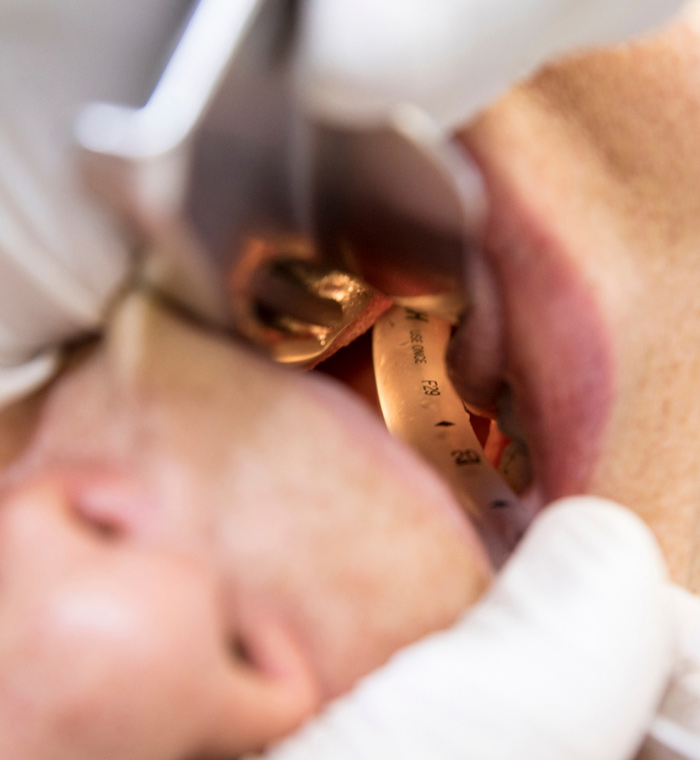
Tongue frenulum incision under local anesthesia
 +381 64 4184 444
Speech, swallowing, or breastfeeding difficulties are often linked to a shortened tongue frenulum. This condition, also known as ankyloglossia, can affect daily functioning and quality of life. If you suspect a shortened tongue frenulum incision at Dr Prlja Medical in Belgrade offers a simple and safe solution. Patients of all ages receive expert evaluation and a personalized approach in a comfortable setting. The consultation is brief, and the procedure is done under local anesthesia without hospitalization. Call us today to book your appointment!

What is the tongue frenulum and how to know if there is a problem
The tongue frenulum is a thin mucous membrane that connects the underside of the tongue to the floor of the mouth. In most people, it allows normal tongue movement, but when it is shorter or thicker, it can limit mobility. This condition is called ankyloglossia, or a shortened tongue frenulum. Symptoms vary by age.
- In children, limited tongue mobility can make it harder to pronounce sounds that require tongue elevation or precise placement—such as T, D, N, L, R, S, Z, as well as the interdental sounds TH. A shortened frenulum may also contribute to chewing problems, snoring or obstructive sleep apnea. If the tongue cannot move properly, it tends to rest low in the mouth and fall back during sleep.
- In older children and teens, the issue may become more obvious in social settings where speech matters more. It may also cause other common ENT problems in children like speech disorders, breathing issues, or chronic oral infections.
- Adults may feel tongue tension, discomfort while speaking, gum recession, or trouble with eating and oral hygiene.
If symptoms interfere with daily life, an ENT evaluation is recommended. Diagnosis should be based on functional assessment, not just appearance.
What the frenulum exam looks like in children and adults
At our clinic, the frenulum exam starts with a consultation with our ENT specialists. For children, parents describe the symptoms they have observed. For adults, a detailed medical history is taken, including:
- any speech difficulties
- feeling of tongue tension
- problems with oral hygiene
Our team will assess whether a tongue frenulum procedure is necessary
Next comes the visual and functional examination. The doctor carefully evaluates the length, thickness, and position of the frenulum, as well as tongue mobility:
- can the patient stick out their tongue
- can they lift it toward the palate
- is the musculature compensating (e.g., do the jaw and neck muscles try to make up for the restricted movement)
For children, a simple test is often used—such as trying to lift the tongue tip above the upper lip. Parents may stay during the entire exam and ask questions. The exam takes about 20 minutes, and the results are available immediately. No preparation is needed.
What are the degrees of tongue frenulum shortening and what do they mean in practice
Tongue frenulum shortening is classified based on tongue mobility—specifically, how far the tongue tip can lift relative to the lower incisors.
- In severe cases (0–3 mm), speech and swallowing may be significantly impaired.
- Moderate cases (4–6 mm) often cause issues that require evaluation and possible treatment.
- Mild ankyloglossia (7–9 mm) usually causes no symptoms, but a child or adult may be referred for monitoring or speech therapy.
- If tongue mobility measures 10 mm or more, the frenulum is not considered functionally restrictive.
In addition to the frenulum’s physical length, a functional assessment is done to see if the tongue can lift, move, and work properly in speech and feeding.
If you are experiencing problems caused by the tongue frenulum incision under local anesthesia is the right solution
A tongue frenulum procedure, also known as frenulotomy or frenectomy, is a simple intervention where part of the frenulum is cut or removed to improve tongue mobility. Depending on the clinical findings, the procedure can be performed:
- surgically with scissors or a scalpel
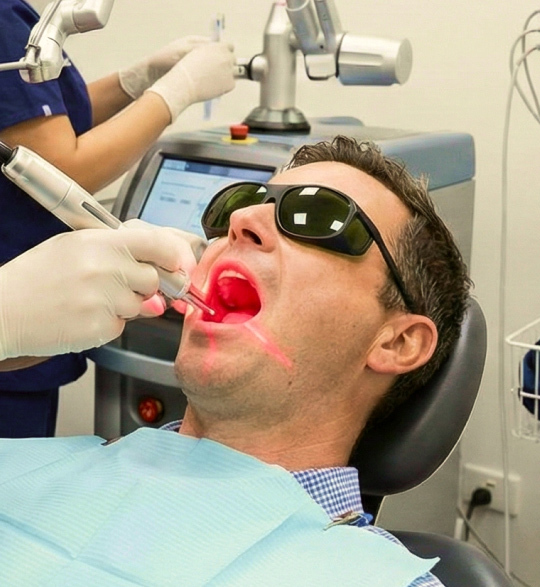
- with a laser (diode, CO₂, or Er:YAG laser)
The procedure itself is very short—typically lasting between 5 and 15 minutes. In children, frenectomy is almost always performed under local anesthesia, either as a gel or by injection.
The procedure is not painful, and patients go home immediately after.
What happens after the procedure
Recovery after frenectomy is usually quick and does not require stitches, except in more complex cases involving frenuloplasty. Complications are rare but may include mild bleeding, irritation, temporary swelling, and discomfort while speaking. Most patients, including children and adults, can eat and speak within a few hours to one day after the procedure.
For older children and adults, gentle tongue mobility exercises are recommended, such as lifting the tongue toward the palate and making circular motions, to prevent tissue reattachment (re-adhesion). These exercises are done several times a day, typically for 7 to 14 days after the procedure.
Speech therapy is advised when speech issues developed before the procedure, as incorrect pronunciation habits may persist even after the physical restriction is removed.

A follow-up appointment is usually scheduled within 7 to 10 days. The doctor checks healing, tongue mobility, and whether additional therapies are needed. Extra checkups may be necessary if there is renewed tightness, infection, or if tongue movement remains limited.
Full tongue function usually returns within a few days to two weeks after a frenectomy. Recurrence is rare but can happen, especially with posterior ankyloglossia if the deep layer of the frenulum was not fully released. Regular follow-up and open communication with the doctor support the best outcome.
Why choose Dr Prlja Medical for this procedure
At Dr Prlja Medical Clinic in Belgrade, the examination is quick, precise, and performed in safe conditions. Our team has years of experience in ENT diagnostics and pays special attention to working with young children. The examination and diagnosis are done without delay, and no referral is needed to schedule an appointment. Our patients also have the option of additional consultations before making a decision. If you have symptoms that suggest a tongue frenulum incision at our clinic is the right step. The intervention is brief, but the results are long-lasting. Contact us today and schedule your appointment in Belgrade — the first step is simple.
Achieve flawless results with personalized treatments that highlight your natural beauty.
Frequently asked questions and answers
Can a tongue frenulum procedure be done on the same day as the consultation?
In most cases, if the doctor determines the procedure is necessary and there are no contraindications, it can be scheduled the same day or very shortly after, depending on appointment availability.
Is a specific diet required before the procedure?
No, for this type of procedure under local anesthesia, food restriction is not required. However, it’s recommended that children do not eat immediately before the exam to make the experience more comfortable.
Are stitches used after cutting the frenulum?
In most cases, no. Frenulotomy is performed without the need for sutures, as the wound heals quickly and naturally. Stitches are only considered for more complex procedures such as frenuloplasty.
Can a tongue frenulum procedure be performed during pregnancy if needed?
If necessary, the procedure can be done during pregnancy, but it is usually advised to wait until after childbirth unless there is a significant functional problem.
Can a shortened tongue frenulum affect tooth position or jaw development?
Yes, long-term restricted tongue movement can affect lower jaw development, bite, and front tooth alignment—especially in growing children.
Is there a risk of the frenulum reattaching after surgery?
In rare cases, re-adhesion may occur, especially if tongue mobility exercises are not done as recommended. That’s why following medical instructions is important.
Experiences of those who chose us
My experience with Sara was actually my first treatment ever. I had always been skeptical until I met her through a mutual friend. All it took was seeing her flawless skin to completely trust her. Not only does she maintain a natural look, which I really appreciate, with minimal corrections, but she’s also a wonderful friend and, when needed, a great therapist. I always leave her office feeling satisfied and smiling. P.S. She’s the only one who managed to solve my under-eye bags!
-Ksenija Knezevic
Singer
I met Sara a few years ago, and after the first treatment, I was certain – this woman knows what she's doing! I trust her completely, and I love her approach, honesty, and directness. There’s no exaggeration or unnatural looks – just a refreshed, rested, and natural appearance. We always have so much fun, laughing, while also enhancing our beauty. After seeing Sara, I look like I’ve just returned from the best vacation!
-Matea Milosavljevic
Actress
I have known Sara Prlja for more than 15 years, and I can say that everything she envisioned, she has achieved. She has always worked on herself, invested in her knowledge and growth. Her clinic is the perfect place where you will feel comfortable and relaxed, and the service is top-notch. I highly recommend her and her work!
-Aleksandar Dramicanin
Hair & Makeup Artist
Love, trust, and respect are the foundation of every strong and lasting relationship, whether personal or professional. From a medical perspective, we know how essential support is in any healing process, but for me, the relationship between a doctor and a patient is one where trust is especially important. I have complete trust in Sara and always feel confident that everything will be okay. That trust creates a sense of safety and allows real progress, while care and connection give us the space to grow together. I have never viewed my relationship with Sara as just professional, because every time I visit the clinic, it feels more like coming to people I trust and feel close to rather than simply working with a provider. That is the X factor that makes this experience truly valuable to me.

-Nataša Kovačević Njezvanova
Influencer
My experience with Sara has been exceptional in every way. Above all, she is a genuinely kind person and an outstanding professional. Together with her wonderful team, she creates an atmosphere free of fear, where trust comes naturally. I am delighted with the results and feel beautiful, confident, and happy. I wholeheartedly recommend her.

-Mahrina
Singer
I don’t easily trust anyone with my skin care, but the moment I stepped into Dr Prlja Medical, I felt safe and confident in my choice. I wouldn’t replace Sara for anyone else. She combines expertise, warmth, and a genuine love for her profession. Every treatment leaves me feeling refreshed and renewed, both physically and emotionally. Trust me when I say that you are in the right place.

-Anja Ćurčić
Actress
Related Services

Endoscopic Examination
Microscopic removal of a foreign body
Specialist ENT ear examination

Specialist ENT nasal examination
Specialist ENT throat examination
Third tonsil surgery
Tonsil Cryptolysis for Bad Breath

Treatment of hoarseness